

«The Prague Cemetery» , Umberto Eco
- Nikolai Rudenko
- 20 апр.
- 2 мин. чтения
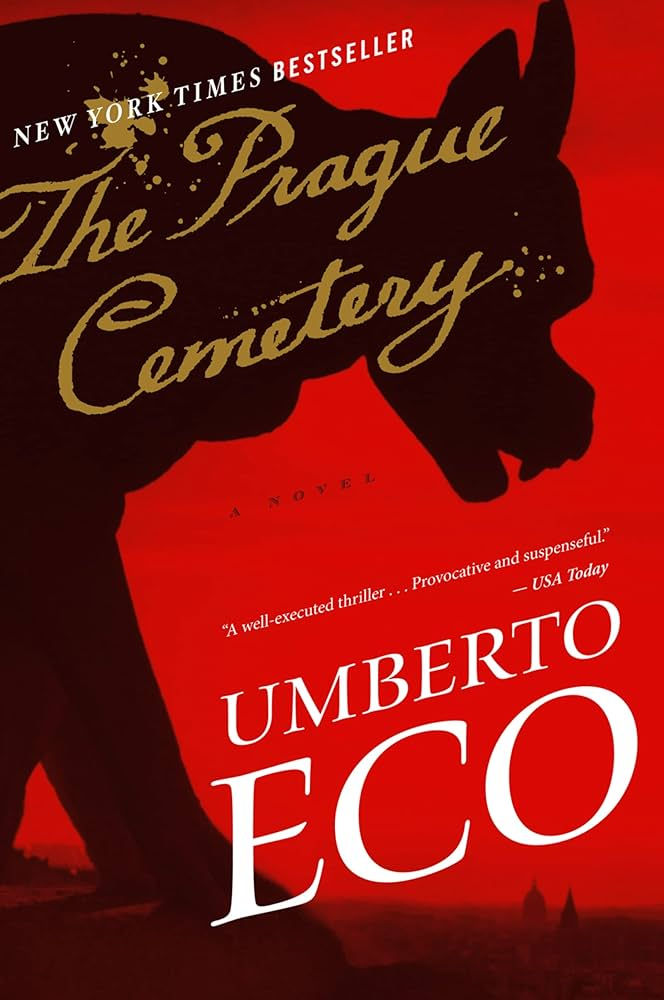
I can’t say exactly why I chose The Prague Cemetery. To be honest, I didn’t know what the book was about. But it turned out that it tells the true story of the creation of the so-called “Protocols.” The “Protocols” had a specific goal: to influence people, their worldview, and their attitude toward Jews. Anti-Semitism is the main theme of this document.
Umberto Eco was an Italian medievalist, philosopher, semiotician, novelist, cultural critic, and political and social commentator. In English, he is best known for his popular 1980 novel The Name of the Rose, a historical mystery combining semiotics in fiction with biblical analysis, medieval studies and literary theory, as well as Foucault's Pendulum, his 1988 novel which touches on similar themes.
I think that nowadays there is a vast amount of literature on all sorts of topics that can influence our understanding of certain things...
“The Prague Cemetery” clearly shows how easy and simple it is to plant an idea in people’s minds—an idea that will grow and develop until it becomes so deeply rooted in their consciousness that it becomes practically impossible to eradicate. But that is precisely the essence of how this idea takes root in our minds.
As a rule, people eagerly swallow what terrifies them, what seems impossible, yet so much like the truth. They swallow it because it’s bait for their minds. All that’s left for them is to finish assembling the puzzle they were given in pieces. But, oddly enough, this puzzle always fits together so easily; all the pieces are in place. It’s just that before, they seemed like separate fragments of something substantial, but now that we’ve been shown what the picture actually looks like, we can easily put all the pieces in their places, and the whole picture becomes clear.
We just needed a nudge in the right direction. ..
People are puppets in the hands of others.
We all have our own principles, concepts, and opinions... They are formed throughout our lives, through our life experiences. Much of this is instilled in childhood. And what is instilled in us during childhood becomes the basis, the foundation for all other experiences.
This foundation was demonstrated by the main character, Simonini.
Throughout the story, he carried with him the principles and ideas instilled in him during childhood and did not stray from them; on the contrary, he developed and refined them. I won’t analyze his character, because I think everyone will have their own opinion of him after reading the book. My opinion is that the concepts instilled in us from childhood have the most significant impact on our future lives. No one is born a fervent fanatic or idealist, a murderer or a clergyman. They become these things. And what mark will WE leave behind? Who knows?


Комментарии